
MQTT and JSON: Exchange Measurement Data Openly and Use It in a Structured Way
Today, machines, sensors, edge devices, and IT systems are increasingly speaking the same language: MQTT for transport, JSON for content. On this page, you’ll learn how these two standards work, why they’ve become established in the industry - and how you can seamlessly integrate your measurement data into such infrastructures using the Delphin Data Center.
Why Open Interfaces Are Becoming More Important in Measurement Technology
Measurement data is no longer generated in just one place. A test stand delivers speeds and temperatures, an energy meter reports consumption values, an outdoor environmental sensor records humidity and air pressure – and in the end, all of this information needs to be stored, analysed and shared together. Proprietary point-to-point connections quickly reach their limits here: every new data source means additional integration effort.
Standardised, vendor-independent protocols solve this problem. They decouple data sources from data consumers and make systems expandable. This is exactly where MQTT and JSON have established themselves as a proven duo.
What is MQTT?
MQTT (Message Queuing Telemetry Transport) is a lightweight messaging protocol that was originally developed for low-bandwidth connections. Today, it is an open OASIS standard and one of the most widely used protocols in the Internet of Things (IoT) and industrial automation.
The Principle: Publish and Subscribe
Unlike in traditional client-server queries, participants in MQTT do not communicate directly with one another. Instead, there are three roles:
- Publisher: A device or application publishes messages on a specific subject, known as a "topic.".
- MQTT broker: The broker is the central intermediary. It receives all messages and distributes them to the intended recipients.
- Subscriber: A recipient subscribes to the topics that are relevant to them and automatically receives new messages as soon as they arrive.
A topic has a hierarchical structure, similar to a file path - for example, work1/hall2/testbench3/measurements. Publishers and subscribers do not need to know each other; they simply need to agree on the topic. A participant can be both a publisher and a subscriber at the same time.mentation
Why MQTT Is So Popular in the Industrial Sector
- Low overhead: Compact messages save bandwidth and are also suitable for mobile or remote connections.
- Data is transmitted as it is generated - without constant polling.
- Scalable: New data sources or recipients can be added without modifying existing connections.
- Reliable: Quality-of-Service levels can be used to specify how reliably a message should be delivered.
- Widespread: From cloud platforms to edge gateways to control systems - MQTT is supported by numerous systems.
MQTT 3.1.1 and MQTT 5.0
In practice, two versions are primarily in use. MQTT 3.1.1 is the long-established version with particularly broad support. MQTT 5.0 extends the protocol to include, among other things, more detailed error messages (reason codes), user-defined properties, and more flexible session management - features that offer particular advantages in larger and more complex installations.
What is JSON?
JSON (JavaScript Object Notation) is a text-based format for describing data in a structured way. Despite its name, it is independent of JavaScript and is understood by virtually every programming language and modern IT system. JSON is human-readable and easy for machines to process.
Data is stored in JSON as key-value pairs. Here is an example of how a test stand might describe its current state:
{
„test stand“: „PS-03“,
„RPM“: 1480,
„oil temperature“: 68.4,
„in_betrieb“: true
}
Even this simple example demonstrates the power of JSON: Multiple pieces of information of different types - text, integers, floating-point numbers, and boolean values - are combined into a single, clearly structured message. Each value conveys its own meaning.
MQTT and JSON: How Transport and Content Work Together
MQTT defines how a message is transmitted from the sender to the receiver. However, the protocol does not specify what data the message contains or how it is structured. This payload can essentially be anything - and this is exactly where JSON comes into play.
The division of labor can be summarized simply: MQTT is the envelope, and JSON is the structured letter inside it. Because both standards are open and widely used, devices and applications from a wide variety of manufacturers can exchange data without the need for specially tailored formats.
Typical Applications
- Industrial IoT and Condition Monitoring: Condition data from machines and equipment is collected and monitored centrally.
- Test stands and laboratory applications: Measurement data from various sources is fed into a shared database.
- Energy and Environmental Monitoring: Distributed meters and sensors report their readings to a higher-level system.
- Edge and Cloud Connectivity: Data collected locally is transmitted to IT, MES, or cloud platforms
MQTT and JSON in the Delphin Data Center
With Release 26.2, the Delphin Data Center even become an MQTT subscriber. A built-in MQTT client and a new JSON parser make it possible to exchange measurement data directly with MQTT-based systems—in both directions.
Receiving Data: Subscribe and JSON Parsing
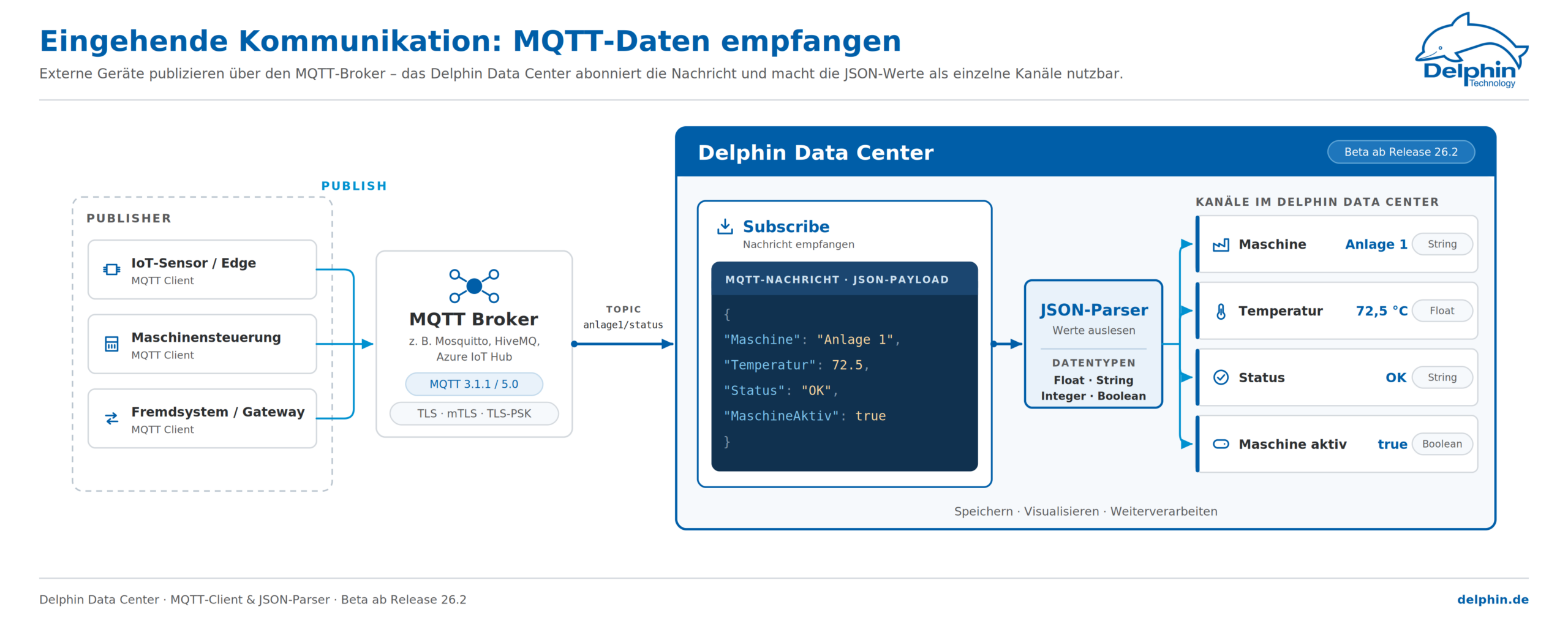
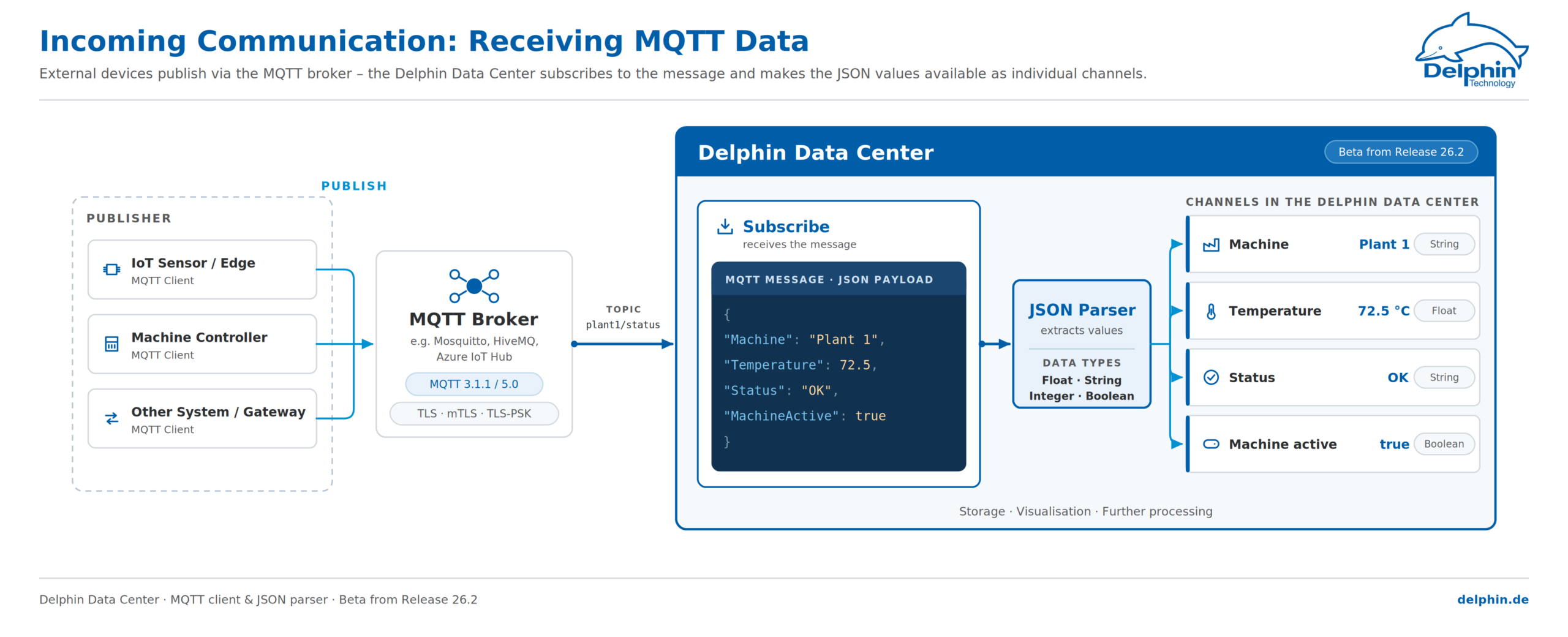
The Delphin Data Center subscribes to the desired topics on an MQTT broker and receives messages from external devices and systems. If a message contains JSON data, the JSON parser extracts the required values from the structure. Each of these values is then available as a separate channel - for storage, visualization, and further processing - just like any other metric in the Data Center.
Based on the JSON example above, this would result in four separate channels:
| JSON key | Data Type | Sample value | Duct in the Data Center |
|---|---|---|---|
| test stand | String | „PS-03“ | Test Stand ID |
| RPM | Integer | 1480 | RPM [1/min] |
| oil temperature | Float | 68.4 | Oil Temperature [°C] |
| in operation | Boolean | true | Operating Status |
The following data types are supported: float, integer, string, and boolean.
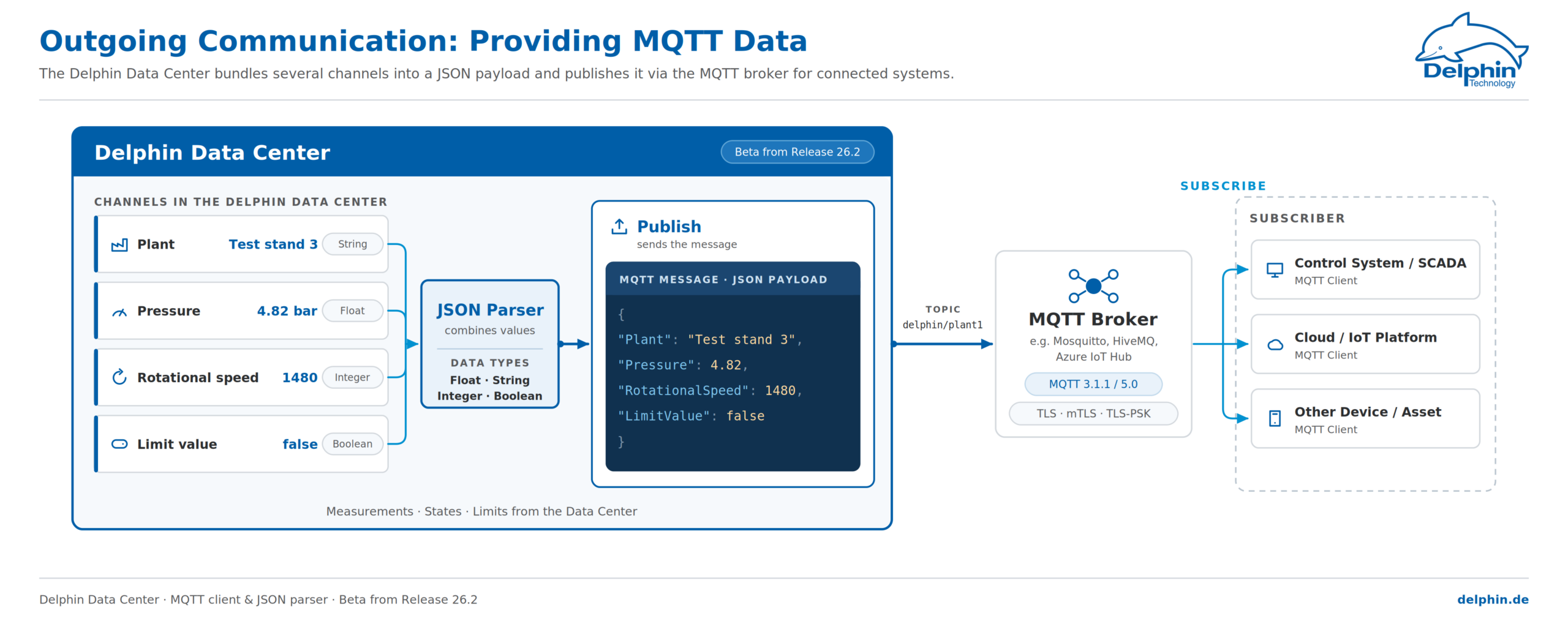
Provide data: Publish
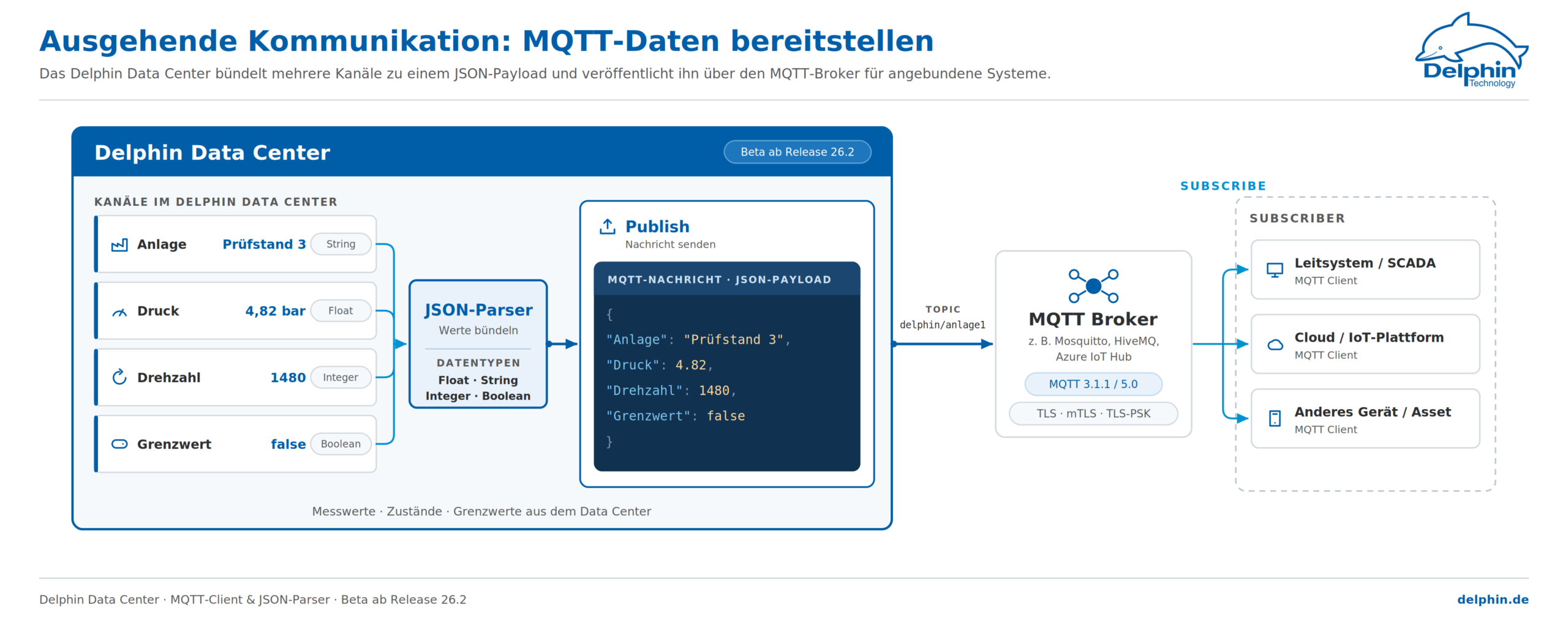
Conversely, the Delphin Data Center can publish values from its channels as MQTT messages with JSON payloads. Other applications - such as a control room, an MES, or a cloud platform - can simply subscribe to this data via the broker without having to program a custom interface.
Communicate Safely
A secure connection is essential, especially when measurement data crosses network or site boundaries. The Delphin Data Center supports three methods for this purpose:
- TLS: Encrypts the connection between the data center and the broker.
- mTLS (mutual TLS): Additionally, it authenticates both parties to each other using certificates.
- TLS-PSK: secures the connection using a pre-agreed key - a streamlined alternative when no certificate infrastructure is available.
Your Benefits at a Glance
- Two-Way Communication: Subscribe to and Publish Data in a Single Solution
- Compatible with MQTT 3.1.1 and MQTT 5.0
- Structured JSON data can be used directly as individual channels
- Secure connections via TLS, mTLS, or TLS-PSK
- Easy integration into existing machine, IoT, edge, and IT infrastructures
Frequently Asked Questions About MQTT and JSON
What is the difference between MQTT and JSON?
MQTT is a communication protocol that governs the transmission of messages between devices and applications. JSON is a data format that describes how the content of a message is structured. In practice, the two are often used together: MQTT transmits the message, while JSON structures the data it contains.
Why do I need an MQTT broker?
The broker is the central intermediary in an MQTT network. It receives all published messages and forwards them to the subscribers who have subscribed to the respective topic. The Delphin Data Center connects to a broker as an MQTT client.
Which MQTT versions does the Delphin Data Center support?
The Delphin Data Center supports MQTT 3.1.1 and MQTT 5.0.
Can the Delphin Data Center receive and send data via MQTT?
Yes. The data center can subscribe to topics and thus retrieve data from other systems. At the same time, it can publish its own data and thereby make it available to other MQTT participants.
What data types does the JSON parser process?
The JSON parser in the Delphin Data Center processes the data types float, integer, string, and boolean. The retrieved values are used as individual channels in the Data Center.
How is MQTT communication secured?
To ensure a secure connection, the Delphin Data Center supports TLS, mTLS, and TLS-PSK.
When will the MQTT client and JSON parser be available?
Both features will initially be available as beta versions starting with Release 26.2 of the Delphin Data Center.
Are you planning a project using MQTT or JSON?
Whether you want to connect existing IoT devices, transfer measurement data to a higher-level platform, or network a new system, we’d be happy to advise you on the capabilities of the Delphin Data Center. During the beta phase, we’d especially appreciate hearing about your use cases and receiving your real-world feedback.