
Vibration measurement technology Expert Vibro
Modern vibration specialist as an all-in-one system
Whether in production, maintenance or development - machine downtimes and quality problems can only be avoided if you detect critical vibrations at an early stage. The Expert Vibro offers you a compact, ready-to-use solution for this: vibration data is permanently recorded, intelligently evaluated and analyzed directly in the device. This allows you to seamlessly monitor the condition of bearings, shafts and entire machines and rectify problems in good time.
Thanks to the simple commissioning, flexible sensor connection and integrated evaluation functions, you can quickly implement the Expert Vibro in your existing process - without complex additional systems and with immediately measurable benefits.
Expert Vibro is your key to higher machine availability, more efficient processes and lower maintenance costs.
Product highlights
- Compact all-in-one device for measurement, analysis and monitoring
- 4, 8, 12 or 16 synchronous analog inputs, up to 50 kHz per channel
- 24-bit A/D converter and galvanic isolation for maximum precision
- Integrated FFT analysis and flexible modular signal pre-processing
- Support for voltage, IEPE and shaft vibration sensors
- Millisecond switching of digital outputs in the event of a limit value violation
- Permanent operation with internal 32 GB data memory
- Simple programming via software channels without expert knowledge

I/Os and interfaces
The clear display of all inputs and outputs as well as communication interfaces enables efficient system integration and uncomplicated commissioning.
Input signals
- Voltage/Currents
- Digital input
- Frequencies
Output signals
- Voltage/Currents
- PWM
- Digital output

Expert Vibro
Interfaces
- LAN
- USB
- RS 232/485
Protocols
- PROFINET
- PROFIBUS
- CAN
- Modbus TCP
- Modbus RTU
- OPC UA
- OPC UA HA
Here you will find an overview of the standard and optionally available Hardware interfaces and protocols. Find out more about the interface diversity our measurement technology software.
As a user, you can switch flexibly between measuring voltages, IEPE or shaft vibration sensors. Typical solutions with the Expert Vibro vibration measurement are:
- Shaft vibration monitoring and analysis
- Machine and housing vibrations
- Combustion chamber vibration monitoring
- Gear box analysis
Functions
Expert Vibro - FPGA-supported vibration measurement with integrated FFT analysis
Expert Vibro combines high-precision vibration measurement, intelligent signal processing and autonomous monitoring functions in one compact device. It records vibrations in real time, analyzes them directly in the device and reacts to critical conditions at lightning speed - without additional hardware or long training periods.
- Integrated complete solution - All essential functions such as measurement, analysis, monitoring, data logging and PLC tasks are combined in a single device. This eliminates the need for multiple systems, which reduces costs and installation effort.
- Versatile measurement technology - Choose between 4, 8, 12 or 16 synchronous channels with sampling rates of up to 50 kHz per channel. This means that even fast vibration curves can be recorded precisely - ideal for complex machines or multi-point monitoring.
- Highest precision - The integrated 24-bit A/D converters ensure extremely accurate measurement results. Thanks to galvanic isolation of the channels, measured values are recorded free from mutual interference, which is particularly important for sensitive applications.
- Intelligent real-time analysis - The FFT calculation takes place directly in the device, supplemented by filter, integration and differentiation functions. This means that faults or deviations in the vibration signals are detected immediately without having to calculate using external software.
- Flexible pre-processing - High, low and bandpass filters can be combined with other functions such as rectifiers, integrators or decimators using the modular principle. Several processing chains can be applied to a signal in parallel in order to pursue different analysis objectives simultaneously.
- Speed of reaction - In the event of limit value violations, the system switches its digital outputs within milliseconds. This allows machines to be put into a safe state immediately or processes to be interrupted before damage occurs.
- Self-sufficient operation - Expert Vibro works independently of a PC thanks to internal data storage and continuous monitoring. The measuring and monitoring function remains active even in the event of power failures or communication faults.
- Adaptive & user-friendly - Configuration is carried out simply at the click of a mouse, without in-depth programming knowledge. This reduces familiarization and training times to a minimum.
- Wide compatibility - The device supports various sensor types such as voltage sensors, IEPE acceleration sensors or shaft vibration sensors. This allows it to be flexibly adapted to existing measurement environments.
- Can be used throughout the industry - With a wide range of fieldbus connections, analog and digital inputs and outputs, Expert Vibro can be easily integrated into existing automation and monitoring systems.
- Cost efficiency - Fewer devices, fewer interface problems and lower maintenance costs lead to significant savings in procurement, operation and training.
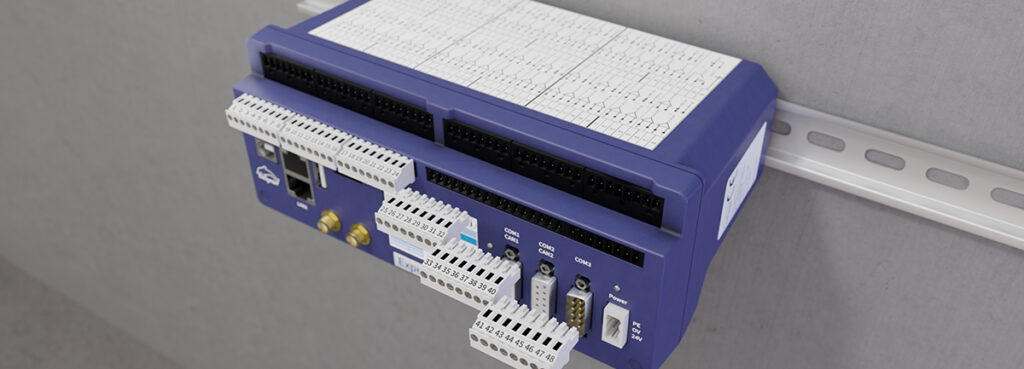
Expert Vibro - illustration with detachable screw terminals
Versions
Expert Vibro - Flexible in every version for your application
Expert Vibro is available in different versions to meet the exact requirements of your application. Depending on the application, you can choose between models with 4, 8, 12 or 16 synchronous measurement channels - all equipped with high sampling rates of up to 50 kHz per channel and 24-bit A/D converters for maximum precision. The compact device variants always offer the same range of functions, from integrated FFT analysis and modular signal pre-processing to fast digital switching outputs.
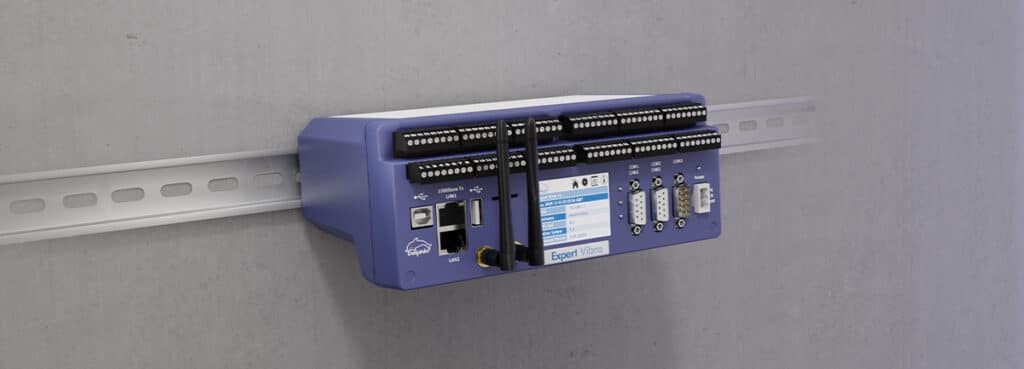
Expert Vibro - Available with 4, 8, 12 or 16 analog inputs
| Inputs / Outputs | Type 4 | Type 8 | Type 12 | Type 16 |
|---|---|---|---|---|
| Analog inputs (mV, mA) | 4 | 8 | 12 | 16 |
| Analog outputs (mV, mA) | 4 | 4 | 4 | 4 |
| Digital / Frequencies inputs | 4 | 4 | 4 | 4 |
| Digital outputs | 8 | 8 | 8 | 8 |
Here you will find an overview of the standard and optionally available Hardware interfaces and protocols. Find out more about the interface diversity our measurement technology software.
FAQ
The Expert Vibro is a compact all-in-one system for vibration measurement, analysis and monitoring of machines, shafts, bearings or complete systems. Areas of application include production, mechanical and plant engineering, test stands, turbine/generator monitoring, gearbox or bearing diagnostics.
The most important features include:
- Compact all-in-one device: measurement, analysis and monitoring in one system
- Choice of 4, 8, 12 or 16 synchronous analog inputs with sampling rates of up to 50 kHz per channel
- 24-bit A/D converter and galvanic isolation of the channels for maximum measurement precision
- Integrated FFT analysis and flexible pre-processing (filter, integrator, differentiator, etc.)
- Self-sufficient operation with 32 GB internal data logger memory for permanent data logging even without a PC
- Flexible sensor connection: voltage, IEPE, shaft vibration sensors
- Extensive interfaces and protocols (e.g. LAN, USB, RS232/485, PROFIBUS, PROFINET, Modbus, OPC UA) for integration into any communication structures
The Expert Vibro supports a wide range of different sensors and signal types. It has analog inputs for connecting voltage, current and IEPE signals as well as acceleration and distance sensors, which are used to monitor the shaft position or orbit. Digital inputs are also available, for example for connecting speed triggers. On the output side, both analog signals and digital switching outputs can be used to react immediately if limit values are exceeded.
The Expert Vibro can be seamlessly integrated into industrial monitoring and automation systems thanks to its extensive interface and protocol support. It can be embedded directly into existing communication structures via fieldbus and Ethernet connections such as PROFIBUS, PROFINET, Modbus or OPC UA. LAN and USB interfaces are also available for data transfer, configuration and remote monitoring. Thanks to the self-sufficient data acquisition, the device also works independently of a permanent PC connection, which makes it easier to use in decentralized or difficult-to-access systems.
The Expert Vibro can be flexibly expanded and adapted to different requirements. Depending on the application, a suitable channel configuration with 4, 8, 12 or 16 channels can be selected. As requirements grow, it can also be combined or networked with other devices, for example via fieldbus. The modular software channels and configurable signal pre-processing make it possible to integrate additional filter, analysis or limit value functions without having to make any changes to the hardware.
- Selection of the appropriate channel variant and input sensors according to the respective measurement task
- Configure sensor connections correctly (voltage, IEPE, shaft vibration, etc.)
- Define network and communication parameters (IP, fieldbus settings)
- Configure filter, analysis and limit value parameters
- Set up data logger and memory functions
- Machine and system monitoring (especially rotating machines)
- Energy and power plant technology (e.g. turbines, generators)
- Manufacturing and production companies with high demands on system availability
- Testing technology and service life test stands (e.g. bearings, gearboxes).
- Condition monitoring, predictive maintenance
- Mission-critical environments with high demands on measurement precision and reliability
Technical specifications
| Analog inputs | 4, 8, 12 or 16 synchronous sampling |
| Sampling rate, adjustable per channel | 20 Hz .. 50 kHz |
| Usable signal range | DC .. 20 kHz |
| Voltage range | ± 25 V |
| Current measuring range | 0 .. 20 mA / 4 .. 20 mA / free |
| Signal conditioning, software switchable | None, AC coupling, IEPE |
| Resolution/type ADC / input impedance | 24 bit Sigma-Delta / 4 GΩ |
| Dielectric withstand voltage | ± 100 VDC |
| Galvanic isolation channel to channel / channel to system / PE | ± 400 VDC |
| Measurement accuracy | 0.5 mV + 0.008 % from measurement value |
| Digital inputs | 4 |
| Input signal | low: 0 .. 1 V / high: 5 .. 100 [email protected] mA |
| Galvanic isolation channel to channel / channel to system / PE | ± 400 VDC |
| Max. input frequency / min. pulse width | 1 MHz / 500 ns |
| Analog outputs | 4 |
| Resolution | 16 bit |
| Output ranges | 0 .. 10 V / ± 10 V / 0 .. 20 mA / 4 ... 20 mA / ± 20 mA |
| Galvanic isolation channel to other channel types / Duct to system / PE | ± 400 VDC |
| Min. load / max. burden | 650 Ω |
| Digital outputs | 8 |
| Max. switching voltage / current | 50 V / 2.5 A for 2 seconds, 250 mA continuous current |
| Galvanic isolation channel to other channel types / Duct to system / PE | ± 400 VDC |
| PWM basic frequency / duty cycle | 5 Hz .. 10 KHz / 1:1000 |
| Data storage | |
| Internal / external | 32 GB (approx. 2,300 million measured values) / USB, NFS, CIFS, (S)FTP |
| Signal comditioning functions | |
| High-pass / low-pass / bandpass filter | |
| Cut-off frequency / filter order / filter characteristic | 5 .. 20 kHz / 4, 6, 8, 10 / Butterworth; Chebyshev, Bessel, Critical Damping |
| Analysis | |
| Integrator / Differentiator | Single or double integrator / differentiator |
| FFT | |
| Line number / window function / averaging | 100 .. 12.800 lines (zero padding up to 32k points) / von-Hann, Hamming, Flat-Top, Tukey / 2 .. 32 times |
| FFT types | Narrow band / wide band, envelope / demodulation, amplitude / phase spectral |
| Characteristic values from time signal | |
| Maximum / minimum value, peak-to-peak value, arithm. average, RMS, max. vect. sum, air-gap, crest factor | |
| Characteristic values from frequency spectrum | |
| Amplitude, frequency and phase of main oscillation and any harmonics, sum value, quadratic mean (in any frequency band), value remainder | |
| Amlitudes for various damage frequencies of rolling bearing, gear stage, planetary stage | |
| Characteristic values on digital input | |
| Frequency | 0.2 Hz .. 1 MHz |
| Counter | 64 bit, UP-Down counter, quadratur decoder |
| Interfaces | |
| Physical equipment COM 1 / COM 2 | RS485, 9-pole sub-D socket, IEC 61158-2 |
| Physical equipment COM 3 | RS232, 9-pole sub-D-plugs |
| LAN | 1 x 1000BASE-T |
| USB | Device 2.0 / Host 2.0 / low / high / full |
| PROFIBUS | 2 x PROFIBUS DPV1 / Slave max. 12 Mbit, also redundant according to PNO 2.212 V1.2 |
| CAN / RS 232/485 | 2 x CAN 2.0 / Modbus RTU Master & Slave, SCPI, ASCII |
| TCP/IP | Modbus TCP Server & Client, OPC UA Server & Client, OPC UA HA Server (optional), SMTP, NTP, PTP |
| PROFINET (TCP/IP) | PROFINET RT Device, IO/MRP/LLDP, Conf Class B, RT Class 1, Netload Class III, I&M 0,1,2,3,5, 2xRJ45 100MBit/s full duplex |
| General technical information | |
| Dimensions / weight | W 217 mm x H 88 mm x D 128 mm / 750 g |
| Fixing | Mounting rail DIN EN 60715 or screw mounting |
| Connecting terminals | Plug-in screw terminals, 96 terminals in 2 rows, max. 1.5 mm² |
| Temperature range | -20 .. 50 °C* |
| Humidity | max. 90 % relative humidity, non-condensing |
| Supply voltage | 12 .. 24 VDC / ± 10% |
| Power input | Max. 20 watts |
* Sufficient air circulation in the control cabinet must be ensured.
Status: 20.02.2025
Software
Software interfaces
Modern software interfaces make Expert Vibro compatible with common industrial and IoT systems.
Interfaces
- OPC (Server/Client)
- OPC UA (Server/Client)
- OPC UA HA (Server)
- API
- Python
- SQL
- LabView
- Diadem
- Modbus TCP
- DasyLab
DataService / Data Center
Expert Vibro
Suitable software for Expert Vibro


Special vibration measurement diagrams
Precise monitoring of machine vibrations and vibration displacements | Powerful tools for frequency and order analysis | Condition monitoring for preventive maintenance | Can be combined with Delphin measuring devices for complete solutions
To the product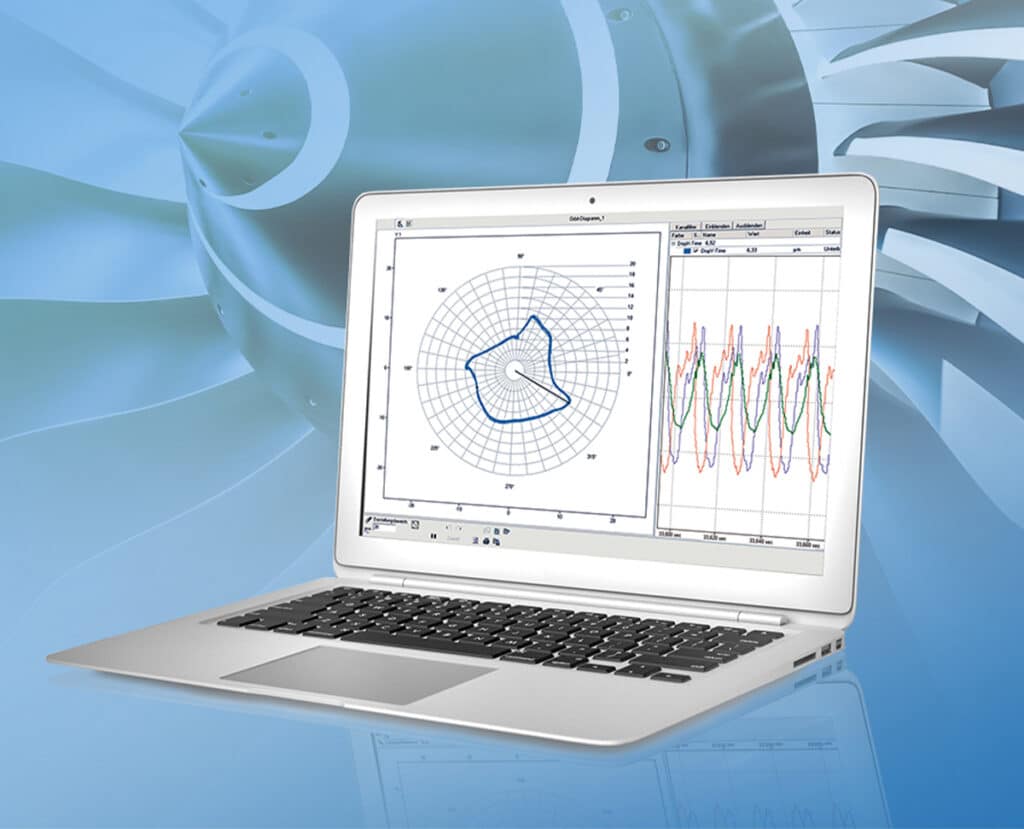
Data acquisition and analysis
Display and monitor measurement data live | Intuitive operation and easy handling without programming knowledge | Versatile diagram and analysis functions for various measurement data | Ready for data acquisition and analysis in just a few minutes
To the product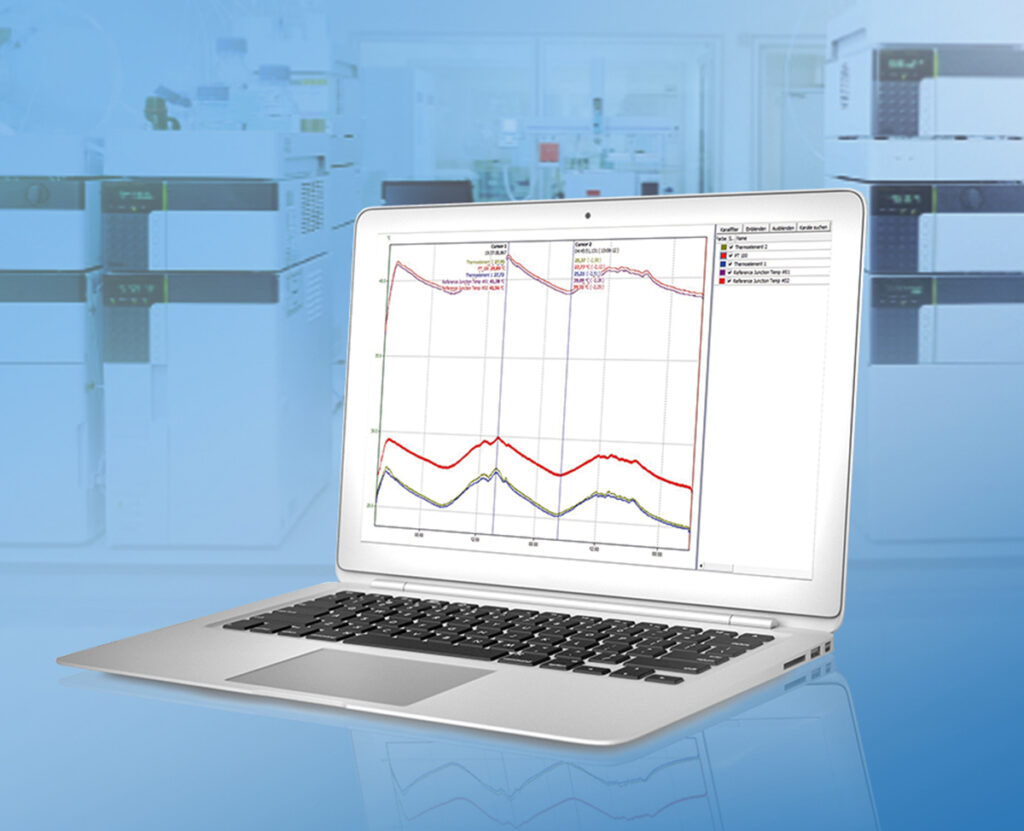
Operating and monitoring
Reliably record and save measurement data | Clearly display and evaluate measured values | Quickly set up and operate projects without programming effort | Ideal for individual measuring stations up to small measuring systems
To the product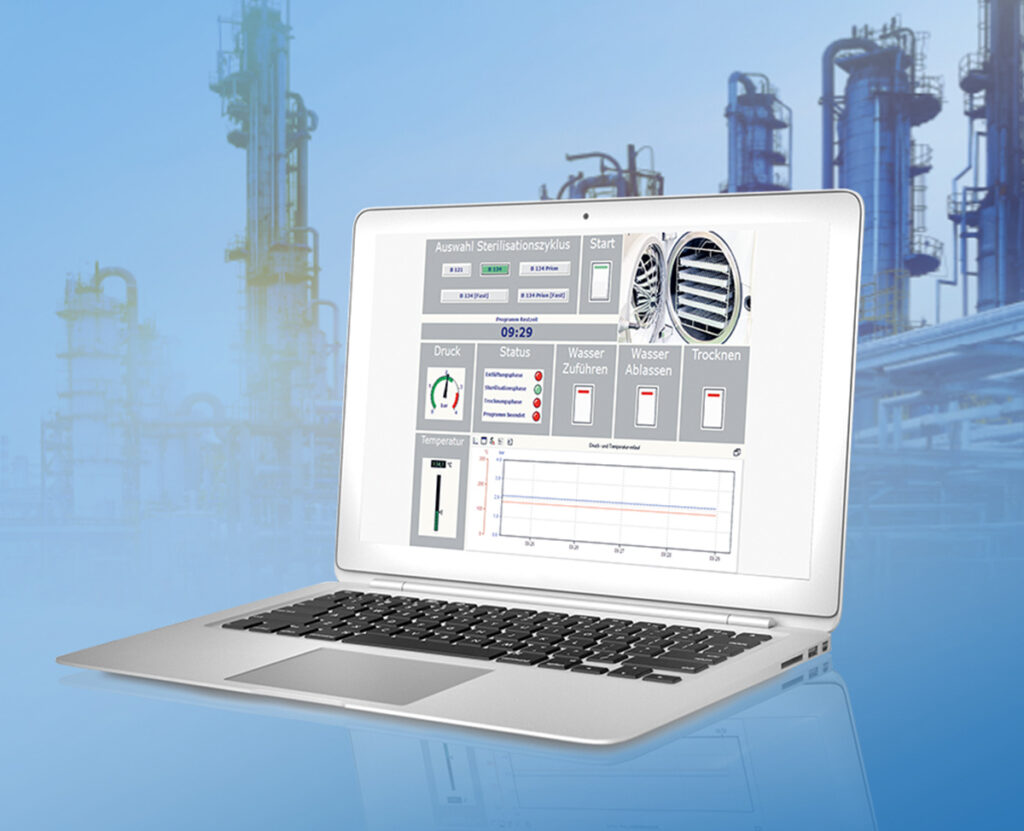
Automate and control
Monitor measurement data and control processes directly | Create automations simply by dragging and dropping | Suitable for complex test benches and automation tasks | Implement and adapt projects without programming knowledge
To the product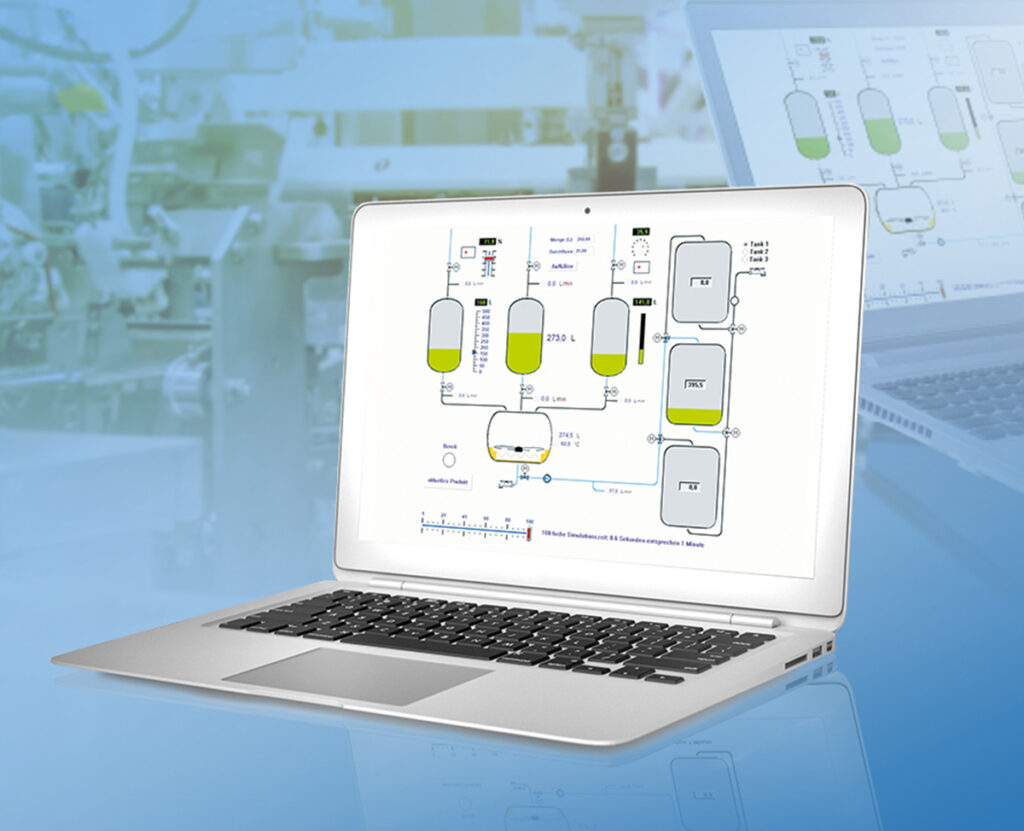
Central measurement data management
Central storage of operating, maintenance and process data | Cross-site real-time monitoring of machine and process statuses | Modular structure makes it easy to adapt to growing plant and process environments
To the product
Visualisation and operation
Easily create your own visualizations for measurement data | Conveniently evaluate and log measurement and process data | Intuitive interface for efficient work without programming knowledge | Ideal for individual measuring stations through to complex monitoring solutions
To the product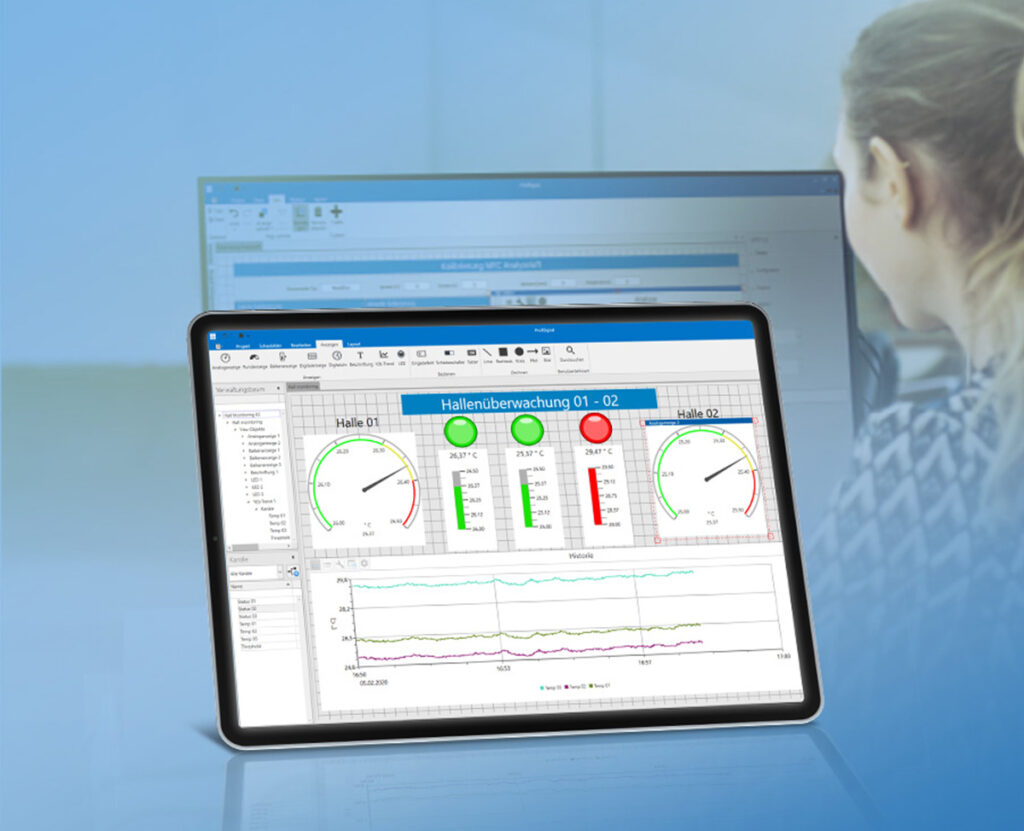
Data acquisition and saving
Display and monitor signals and processes in real time | Easy handling with no training required | Access to measurement data from PC, tablet or smartphone | Ready for many measurement and analysis tasks in just a few minutes
To the product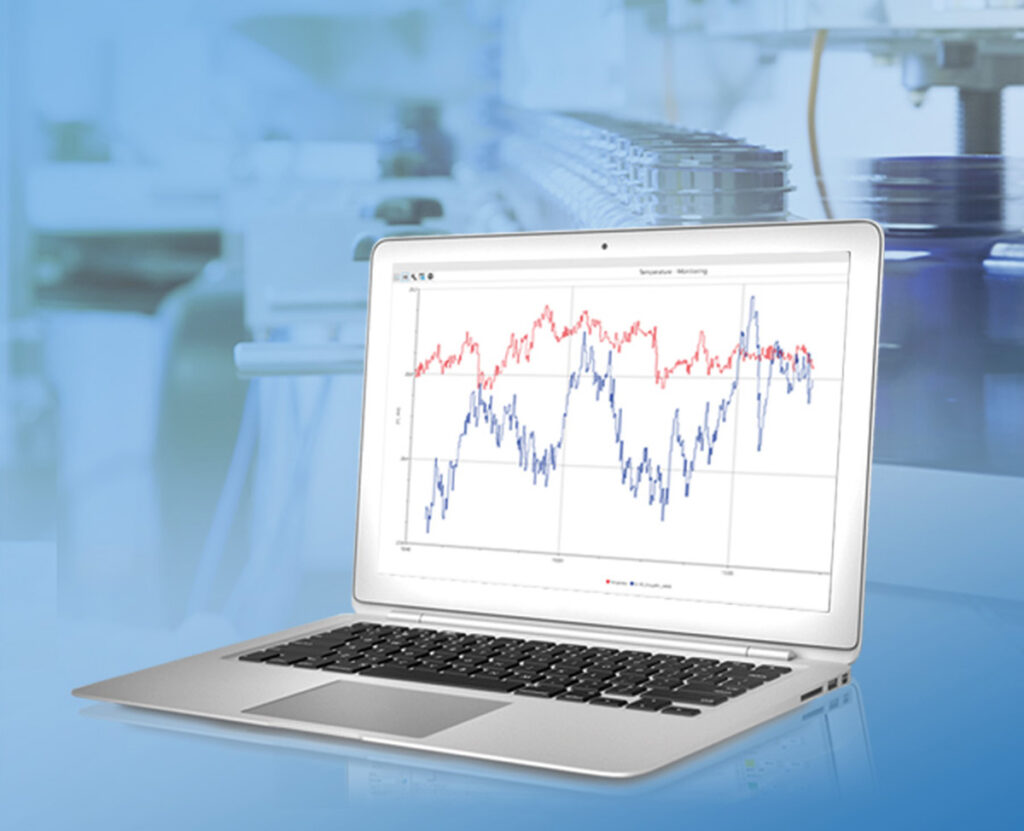
Software channels as extended functions
Realise and execute monitoring and automation tasks easily
Our measuring and testing devices have extended functions, which are summarized under the term software channels. The online measurement data is offset against the software channels and then used for visualization, storage or control.
In this way, entire programme sequences can be configured very simply and intuitively with the regulation and control function. These then run autonomously without PC support. This is how you use your data logger effectively, also as a monitoring device or PLC replacement.
The software channels enable functions such as limit value monitoring, integration or online calculation and are configured very easily. This means that even users who are not experts in programming can easily implement their own monitoring tasks or balancing independently in the unit.
More information