
Sustainable solution to vibration problems in the waterworks
Unclear vibrations jeopardize stable system operation
In a waterworks supplying around 50,000 households, vibration problems occurred over a long period of time in central high-performance pumps. These were not only noticeable in the operation of the system, but were also partially transmitted to the building structure. The exact cause was initially unclear, but it became clear that there was a need for action.

The initial technical situation was challenging: two identical pumps with a redundant design were behaving differently. While one pump ran comparatively smoothly, the other exhibited significantly increased vibration values - particularly in the form of pronounced harmonic vibrations. At the same time, the complex installation conditions in the pump cellar with several units and branched pipelines made it difficult to clearly analyze the causes.
Lack of transparency makes targeted root cause analysis difficult
The main challenge was to clearly identify the actual cause of the vibrations. Without continuous and reliable measurement data, a well-founded assessment was hardly possible. At the same time, the aim was to operate more independently of external specialists in the future and to establish a solution that could be flexibly transferred to other parts of the system.
Continuous monitoring provides clarity about the source of the problem
A permanent vibration monitoring system was installed for systematic analysis. This enabled the continuous recording and detailed evaluation of operating conditions, including by means of Frequency analysis (FFT).
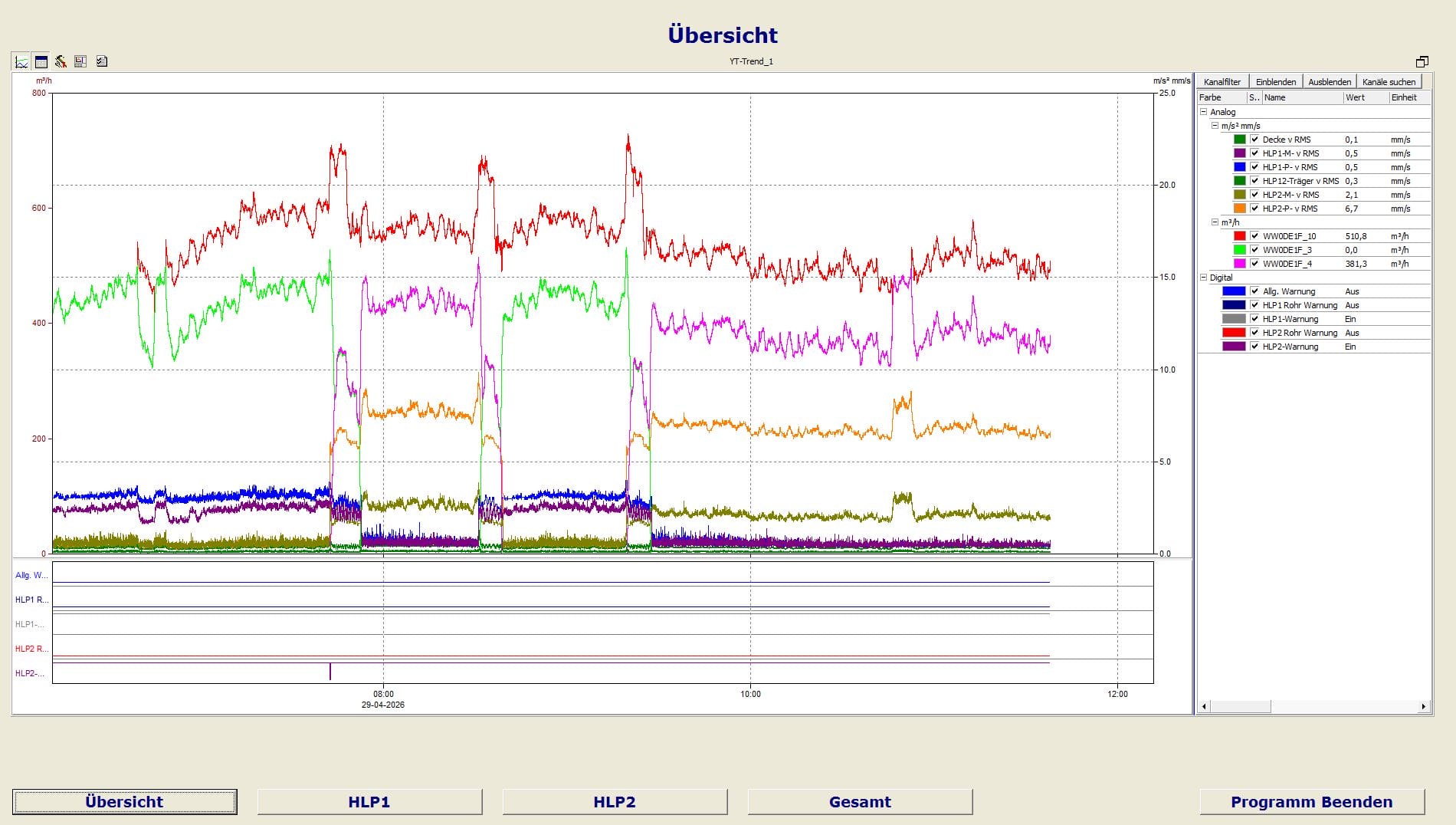
Clear differences between the two pumps could already be seen during the commissioning phase. The conspicuous pump showed significantly higher vibration amplitudes and dominant harmonic vibrations. This allowed the source of the problem to be clearly localized and objectively evaluated for the first time.
Targeted mechanical optimization reduces vibration transmission
Based on the findings, the pump in question was comprehensively revised. It was overhauled by the manufacturer and then placed on a new, deliberately softer foundation. The aim of this measure was to specifically minimize the transmission of vibrations to the building structure.
The installed monitoring system remained active and enabled a direct before-and-after comparison under real operating conditions.
Would you like to find out more?
Measurable improvement confirms effectiveness of the measures
The results were clear: the previously dominant harmonic vibrations were significantly reduced. Although the measured amplitudes increased due to the softer bearing - an expected physical effect - the decisive objective was achieved: the transmission of vibrations to the foundation and thus to the building was significantly reduced.
Since then, system operation has been more stable, more transparent and easier to control.
Data-based maintenance enables a sustainable increase in efficiency
In addition to the immediate technical improvement, the solution also offers long-term benefits. Thanks to continuous data acquisition, the operator now has a reliable basis for decision-making. Potential problems can be identified at an early stage and maintenance measures can be planned in a targeted manner.
Furthermore, the system used can be flexibly expanded. There are plans to integrate further pumps and additional process areas into the monitoring system in order to extend the benefits gained to the entire system.
From an unclear problem to a scalable and future-proof solution
This result shows how an initially diffuse and technically challenging problem can be solved sustainably through the targeted use of modern measurement technology, systematic analysis and mechanical optimization. The transparency gained, the increased operational reliability and the scalability of the solution form the basis for future-proof system monitoring.